
Kling 4.0 vs Seedance 2.5: What the Official Specs Say
Kling 4.0 vs Seedance 2.5, compared only on what Kuaishou and ByteDance have confirmed: 30-second clips, references, keyframes, audio and availability.
 Image To Video AI Team
Most Kling 4.0 vs Seedance 2.5 comparisons written in late September leaned on leaks and predictions, because Kuaishou had barely said anything about its new model. That changed on September 30, 2026, when Kling published its own Kling 4.0 overview. Seedance 2.5 has been out since July 31. For the first time, both sides of this matchup can be compared on what the two companies have confirmed themselves. That, plus what our own site charges, is the only material this article uses.
Where each model stands on October 1, 2026
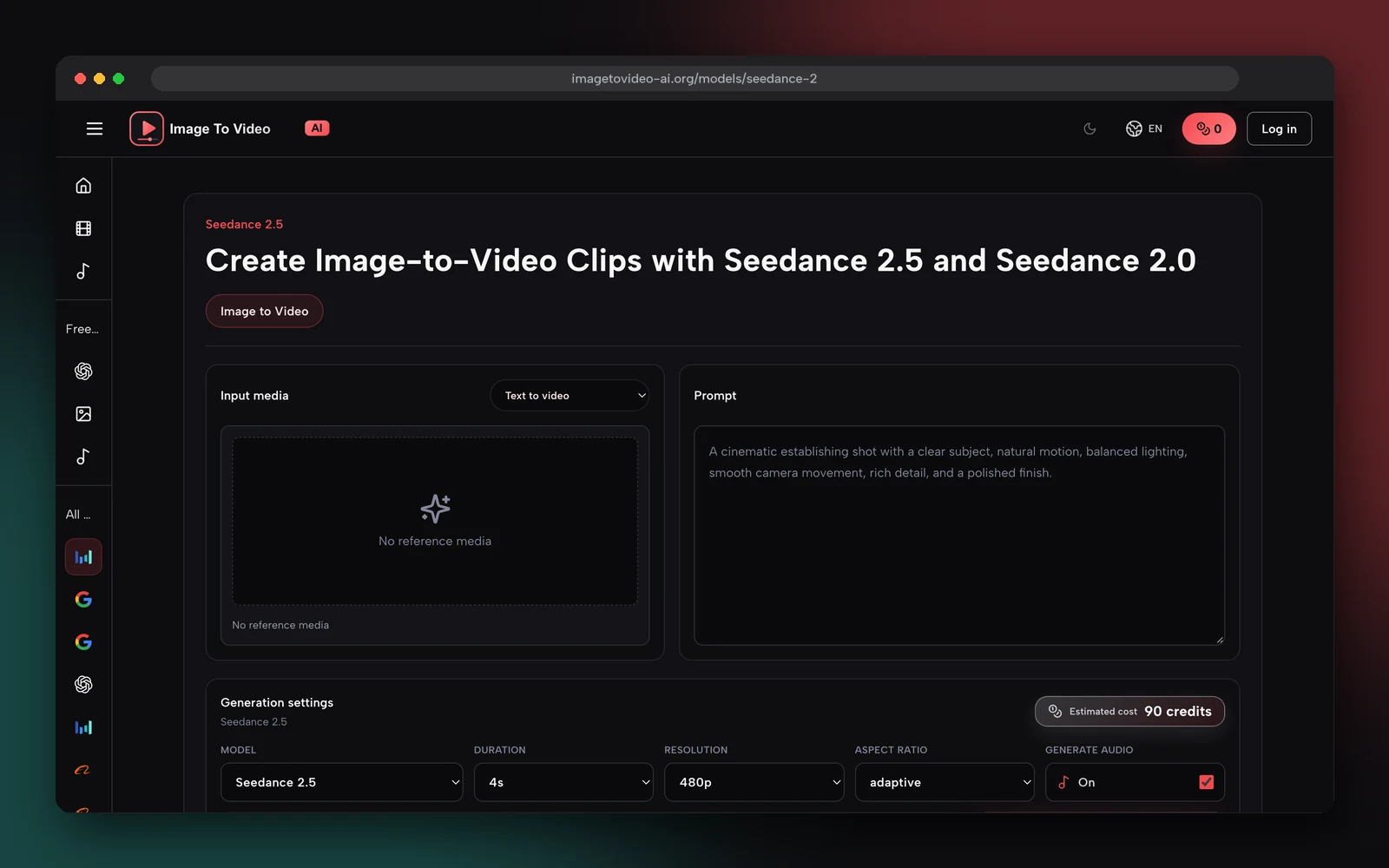
Seedance 2.5 is the video model from ByteDance Seed. It was released on July 31, 2026 and rolled out through Jimeng AI and Doubao Pro, with ByteDance saying API access would follow through BytePlus ModelArk. It is a shipping product that people are using today, including on our Seedance 2.5 page.
Kling 4.0 is the next model in Kuaishou's Kling line, and on Kling's own platform it arrives in two steps. Since September 28, a limited group of users has had early access to Kling 4.0 Flash, a member of the Kling 4.0 lineup with tighter limits: up to 20 seconds per pass, up to 720p in 8-bit SDR, and no first/last-frame or multi-keyframe control. The full Kling 4.0, with the specs in the table below, is scheduled to launch in October 2026.
So an early-access invitation does not get you 30-second clips, 4K or ten keyframes yet. Those come with the full release. That gap in timing matters more than any single number below: if a client needs a cut this week, Seedance 2.5 is the one you can actually use.
Kling 4.0 vs Seedance 2.5: the confirmed spec sheet
Every line in this table comes from the companies' own pages (sources are listed under the table), except the last row, which is what our site charges. Where a vendor has not said something, the cell says so rather than filling the gap with a guess.
| Kling 4.0 | Seedance 2.5 | |
|---|---|---|
| Status | Kling 4.0 Flash in limited early access since Sept 28 (20 s, 720p, no keyframes); full Kling 4.0 launching October 2026 | Released July 31, 2026 |
| Length per generation | 3 to 30 seconds; extend forward or backward over several passes, up to 2 minutes in total | Up to 30 seconds; extend over several rounds |
| Reference inputs | Up to 15 assets in total: up to 10 images, 5 videos (30 s combined), 7 subjects, plus voice | Up to 30 images, 10 video clips and 10 audio clips in one request |
| Shot control | Up to 10 keyframes; prompts up to 8,000 tokens | Timestamp-level edits, camera-angle and green-screen editing |
| Resolution and format | Up to 4K, 21:9 ultrawide; 10-bit HDR at 1080p and 4K (one Kling page still calls HDR "coming soon") | Not stated in ByteDance's announcement |
| Audio and dialogue | Two-channel stereo, improved lip-sync; dialogue in Chinese, English, Japanese, Korean, Spanish, Portuguese, German, French and Hindi, plus regional accents and dialects | Sound and picture generated together; dialogue languages not listed |
| Text inside the frame | The same nine languages, plus emoji | Not stated in ByteDance's announcement |
| Editing existing footage | Up to five input videos (one primary), 30 s combined | Targeted edits pinned to a timestamp |
| Price on imagetovideo-ai.org | Kling 4.0 page: 56 credits per 5-second clip in std mode, 72 in pro, 268 in 4K | Seedance 2.5 page: 112 credits per 5-second clip at 480p, 252 at 720p, 632 at 1080p |
Sources: Kling's Kling 4.0 vs 3.0 overview, Kling 4.0 feature page and Kling 4.0 announcement; ByteDance Seed's Seedance 2.5 launch post.
On resolution: ByteDance's launch post does not give a figure for Seedance 2.5. On our Seedance 2.5 page you can pick 480p, 720p or 1080p, clips of 4 to 30 seconds, and six aspect ratios: 16:9, 4:3, 1:1, 3:4, 9:16 and 21:9.
Thirty seconds each, so length no longer decides
Kling 3.0 stopped at 15 seconds per generation, and anything longer meant stitching clips together. The full Kling 4.0 doubles that to 30 (the Flash version in early access stops at 20). Seedance 2.5 also reaches 30 seconds, which takes clip length off the table as a reason to pick one over the other.
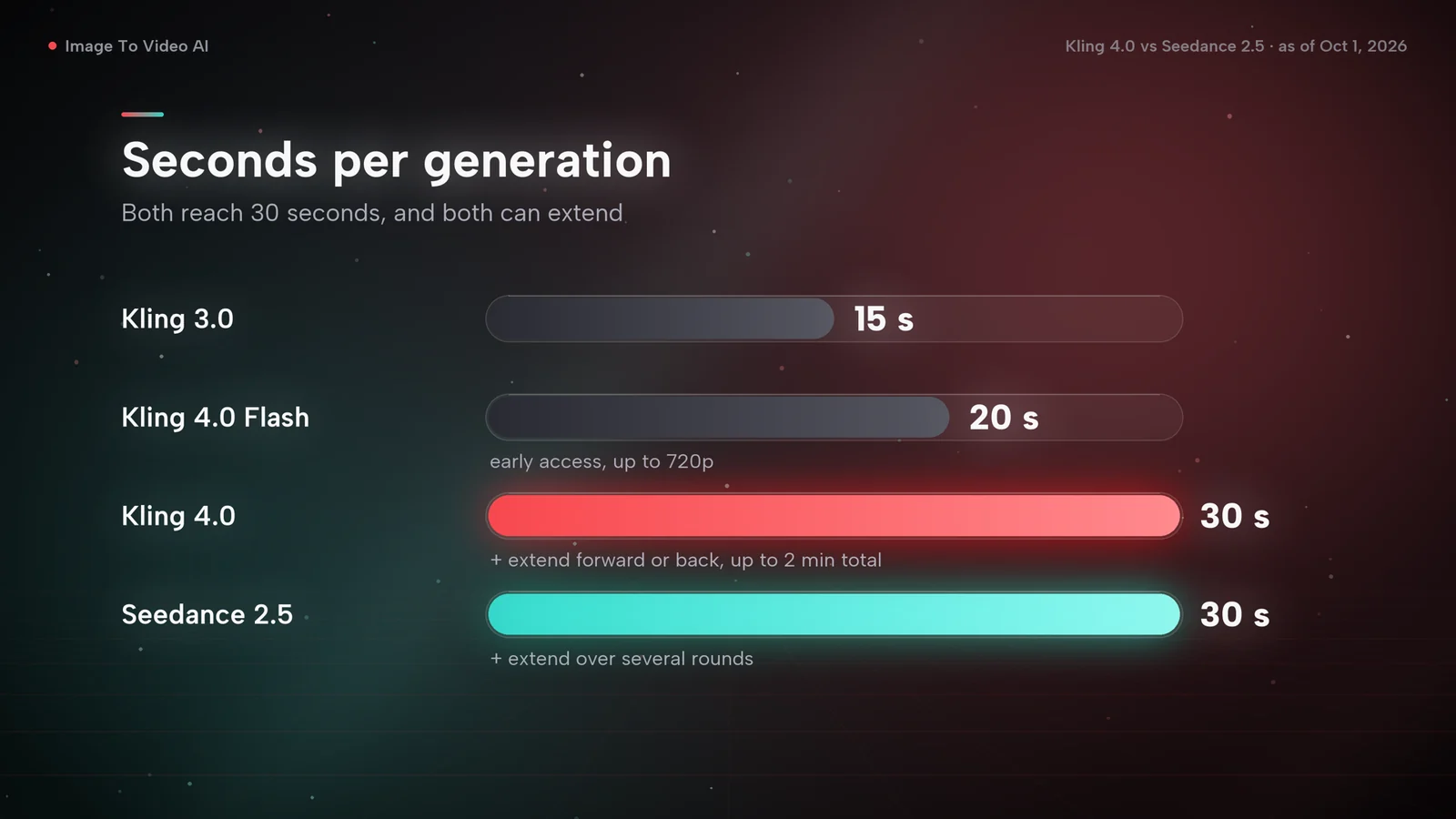
Extension does not separate them either. Kling says Kling 4.0 can extend a video forward or backward across several passes, up to two minutes in total, while keeping subject, scene and camera continuous. ByteDance describes Seedance 2.5 as extendable over multiple rounds with the main characters, the setting and the pacing kept consistent, which is how you get to a piece several minutes long. The real difference is timing: Seedance's extension is part of a model that is already out, and Kling's arrives with the full release in October.
Two ways to steer a shot: keyframes or a pile of references
This is where the two models feel genuinely different.
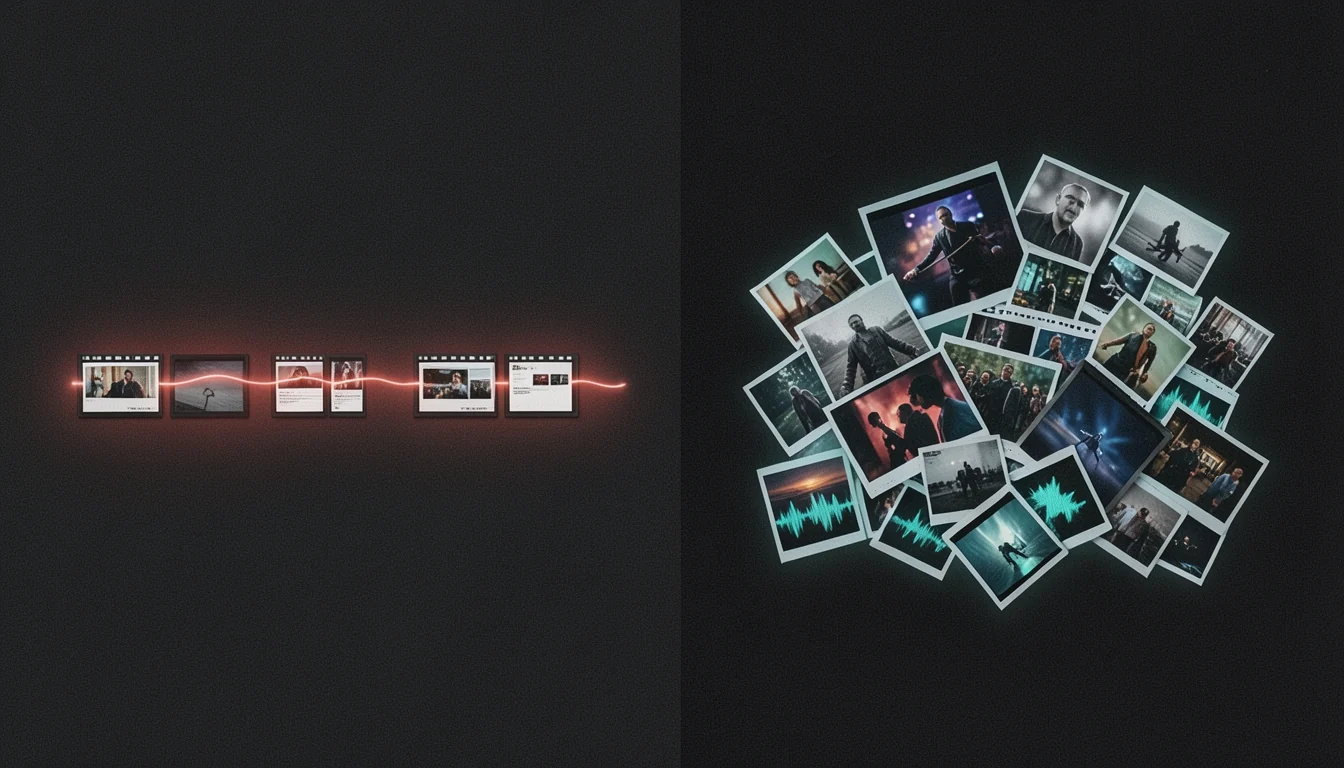
Kling 4.0 is built for direction. Up to ten keyframes let you pin down what the frame should look like at several points in the clip, and prompts of up to 8,000 tokens leave room for a real shot list rather than a one-line idea. Keyframes belong to the full release, not to the Flash version. Its reference system is generous but capped at fifteen assets in total.
Seedance 2.5 is built for material. Thirty images, ten video clips and ten audio clips can go into a single request, so a mood board, a rough cut and a recorded voice line can all inform the same generation. When one moment is wrong, timestamp-level editing lets you change that moment instead of rolling the whole clip again.
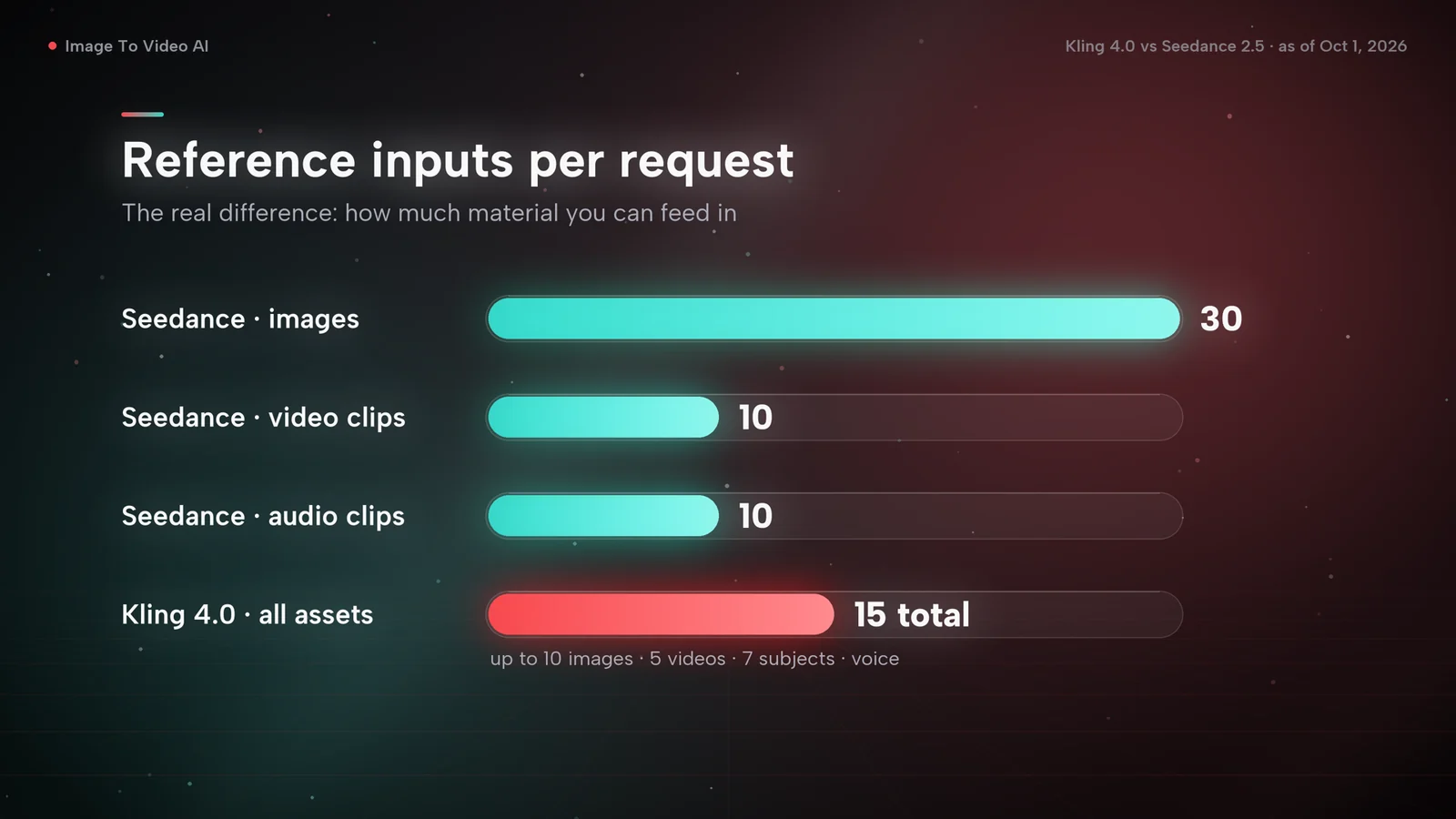
A practical way to choose: if what you start from is a storyboard, Kling's keyframes map onto it directly. If what you start from is a folder of brand assets, Seedance takes more of that folder at once.
Sound, dialogue and text on screen
Both models generate audio together with the picture, so neither needs a separate sound pass for a basic clip. Kling is far more specific about what it has improved: two-channel stereo, more accurate lip-sync, and a longer list of spoken languages. Kling 3.0 handled dialogue in Chinese, English, Japanese, Korean and Spanish; Kling 4.0 adds Portuguese, German, French and Hindi, along with American, British and Indian English accents and Chinese regional speech such as Cantonese and Sichuanese. The same nine languages, plus emoji, are listed for text rendered inside the frame, which matters for signage, product labels and title cards.
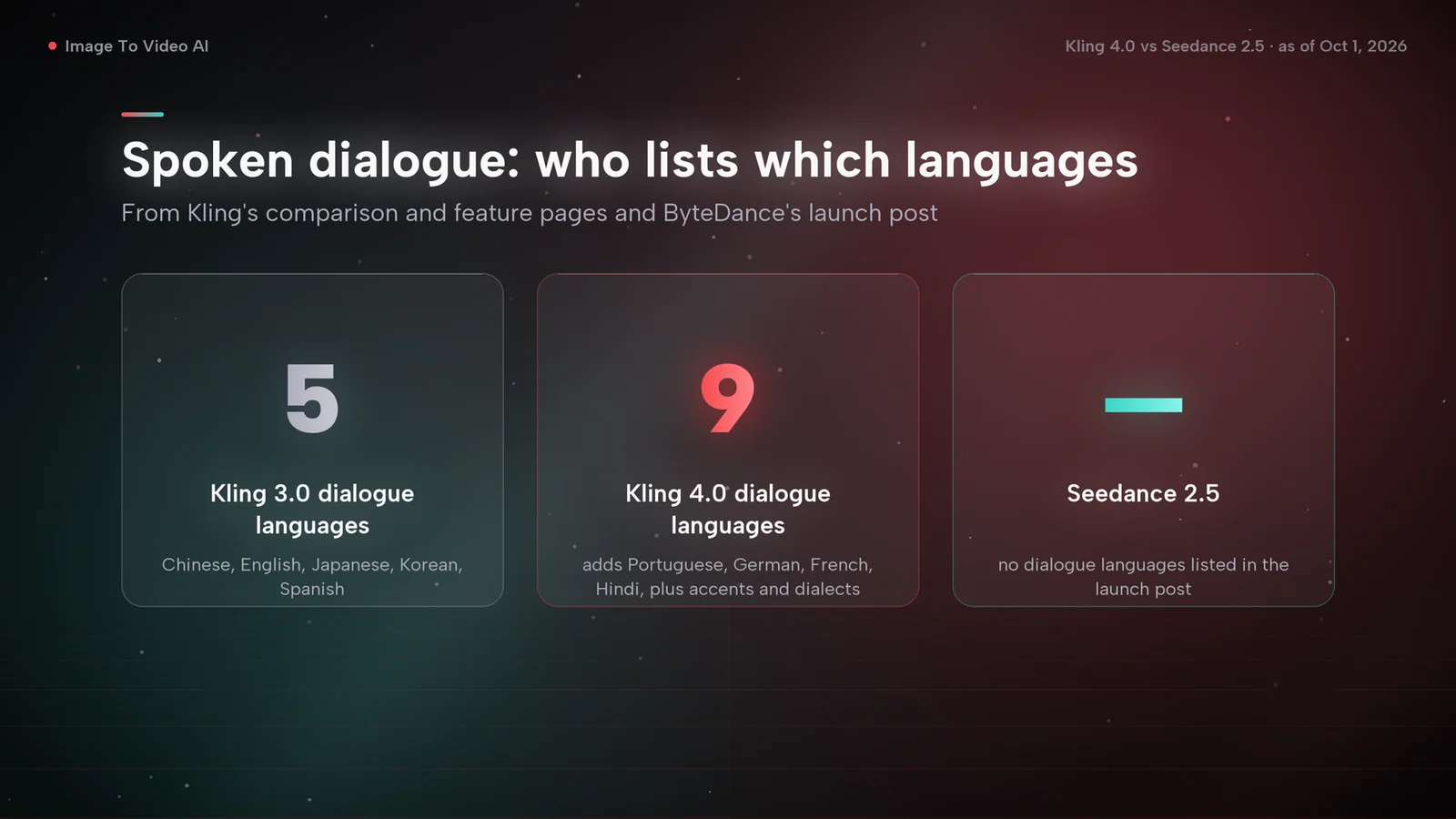
ByteDance describes a joint audio and video architecture for Seedance 2.5, but its launch post does not list dialogue languages and makes no lip-sync claims. That is not proof Seedance cannot do it; it means the claim has not been made.
More detail in an announcement is not the same as better results. If your project depends on dialogue or on-screen text in a particular language, put a line of it into both models and check the output before you commit.
Which one fits your project
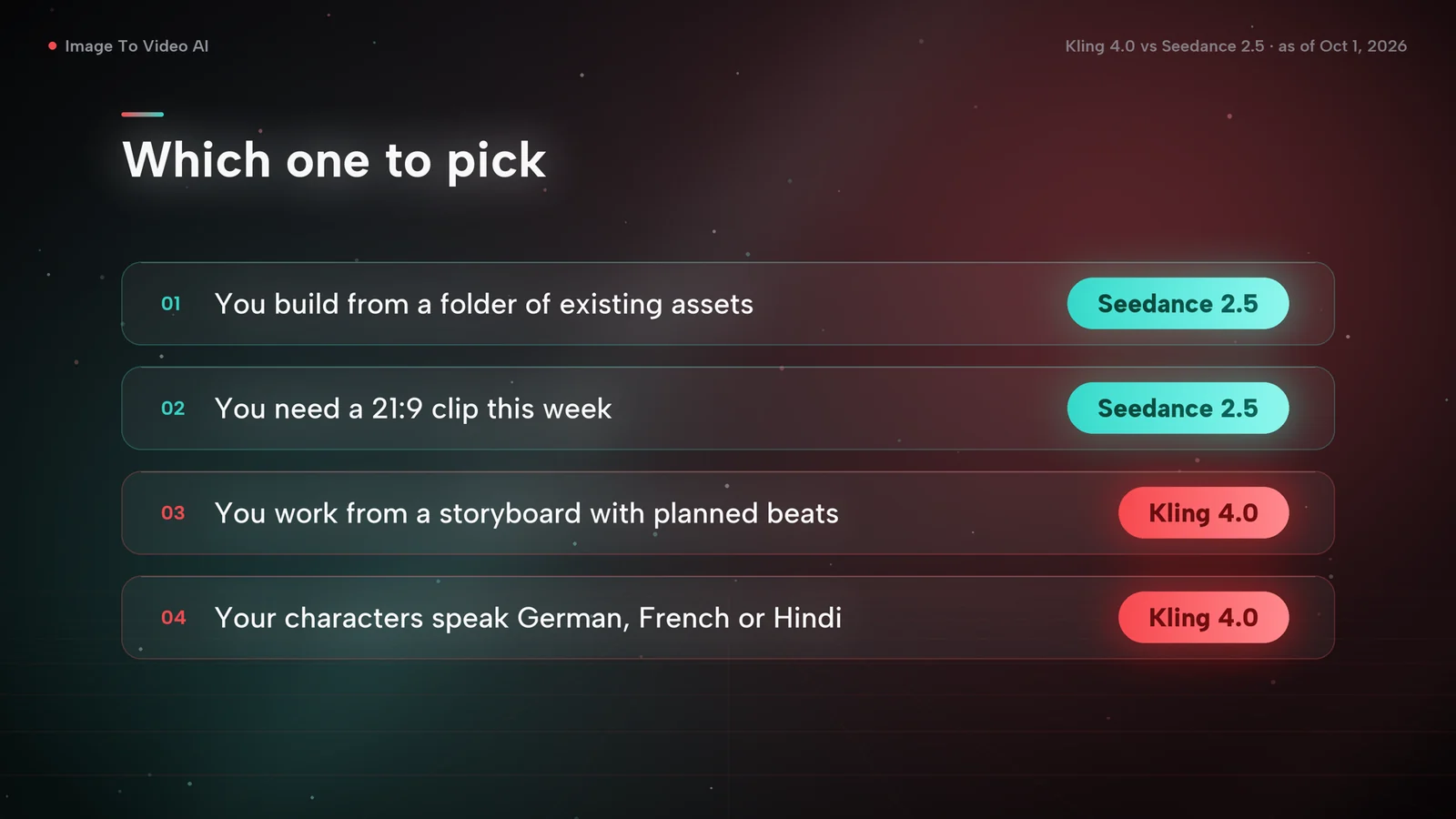
- Product ads assembled from existing assets. Seedance 2.5. It accepts far more reference material, edits by timestamp, and you can run it today on our Seedance 2.5 page.
- Narrative scenes with planned beats and dialogue. Kling 4.0, especially once the full release brings keyframes. It is the one that names its dialogue languages and makes specific lip-sync claims.
- 4K or 21:9 delivery. Kling 4.0 has confirmed both for its full release. ByteDance has not stated a resolution for Seedance 2.5; on our Seedance 2.5 page it runs up to 1080p, in six aspect ratios including 21:9.
- A continuous scene longer than 30 seconds. Either, in principle, since both extend over several passes. Today, Seedance 2.5 is the one where that feature has already shipped.
- Social cut-downs due this week. Seedance 2.5, at 4 to 30 seconds. Kling 4.0 Flash is open only to a limited early-access group, and Kling 3.0 is still on our Kling page.
Run your own side-by-side in about twenty minutes
A spec sheet will not tell you how a face holds up when the camera swings around it. When the full Kling 4.0 reaches your account, run the same small test on both models. Seedance 2.5 is already on our Seedance 2.5 page, so you can do its half now:
- Pick one reference image you have the rights to and one ten-second idea with a clear camera move.
- Write the prompt once and keep it plain: subject, action, camera, light, in that order.
- Generate three times on each model at the same length and aspect ratio (16:9, 9:16 or 1:1 work on both), and judge the best of three rather than the first attempt.
- Score four things: whether the subject stays the same person or product, whether motion produces artifacts, whether the camera move you asked for actually happened, and, if there is dialogue, whether the lips match the words.
- Redo one shot using each model's strength: keyframes on Kling 4.0, a bigger stack of reference material on Seedance 2.5. That second round usually shows more than the first.
What nobody has confirmed yet
- Seedance 2.5's maximum resolution, aspect ratios and dialogue languages, in ByteDance's own words.
- When 10-bit HDR is actually available for Kling 4.0. Kling's comparison and feature pages list it as a spec, while its announcement post says "coming soon".
- Independent benchmarks. Neither launch post publishes quality scores; both describe improvements in general terms.
Frequently asked questions
Is Kling 4.0 available yet?
Not in full. Kling says the full Kling 4.0 launches in October 2026. Since September 28, a limited group has had early access to Kling 4.0 Flash, which tops out at 20 seconds and 720p and has no first/last-frame or keyframe control.
How long can a single clip be?
Both models top out at 30 seconds per generation (Kling 4.0 Flash at 20). Both can also extend a clip: Kling 4.0 forward or backward to two minutes in total, Seedance 2.5 over several rounds. On our Seedance 2.5 page, clips run 4 to 30 seconds.
Which model accepts more reference files?
Seedance 2.5, by a wide margin: up to 30 images, 10 video clips and 10 audio clips in one request, against Kling 4.0's total of 15 reference assets.
Can I use these models on imagetovideo-ai.org?
Seedance 2.5, yes: our Seedance 2.5 page runs it at 4 to 30 seconds, 480p to 1080p, in 16:9, 4:3, 1:1, 3:4, 9:16 or 21:9. Kling 3.0 is on our Kling page, and Kling 4.0 has its own page on the site. For prompting ideas, our earlier guide to Seedance 2.0 image-to-video covers how the previous generation responds to prompts.
How much does it cost on imagetovideo-ai.org?
Generation is paid in credits, and the price scales with length and resolution. A 5-second clip on our Seedance 2.5 page costs 112 credits at 480p, 252 at 720p and 632 at 1080p, so a 10-second 720p clip is 504 credits. On our Kling 4.0 page, a 5-second clip costs 56 credits in std mode, 72 in pro and 268 in 4K. Credit packs and plans are on our pricing page.
Which is better depends on what you are making. Seedance 2.5 is the more complete package today, especially when you build from a stack of existing assets. Kling 4.0 is the one to watch if you work from storyboards and need dialogue that lands in more languages, and its full release in October is when the keyframes and two-minute extension arrive.